

Emotional Flashbacks Explained: Why Feelings From the Past Can Return So Powerfully
Written by Thomas Day, Clinical Professional Counselor in Nevada
Some emotional reactions seem far larger than the situation in front of us.
A brief disagreement with a partner may suddenly feel overwhelming. Constructive feedback at work may produce intense shame. A delayed text message can trigger panic about being abandoned. Moments that appear relatively minor from the outside may evoke powerful emotions that seem difficult to understand or control.
People often wonder:
“Why did I react so strongly?”
“Why do I feel like a frightened child even though I know I’m safe?”
One possible explanation is an emotional flashback.
Unlike the vivid sensory flashbacks often associated with post-traumatic stress disorder (PTSD), emotional flashbacks involve the sudden return of intense emotional states connected to earlier experiences. Although the past is not consciously remembered as though it were happening again, the emotions associated with it can feel immediate and compelling.
Psychodynamic psychotherapy seeks to understand these experiences by exploring how unresolved emotional patterns from earlier relationships continue to influence present-day life.
What Is an Emotional Flashback?
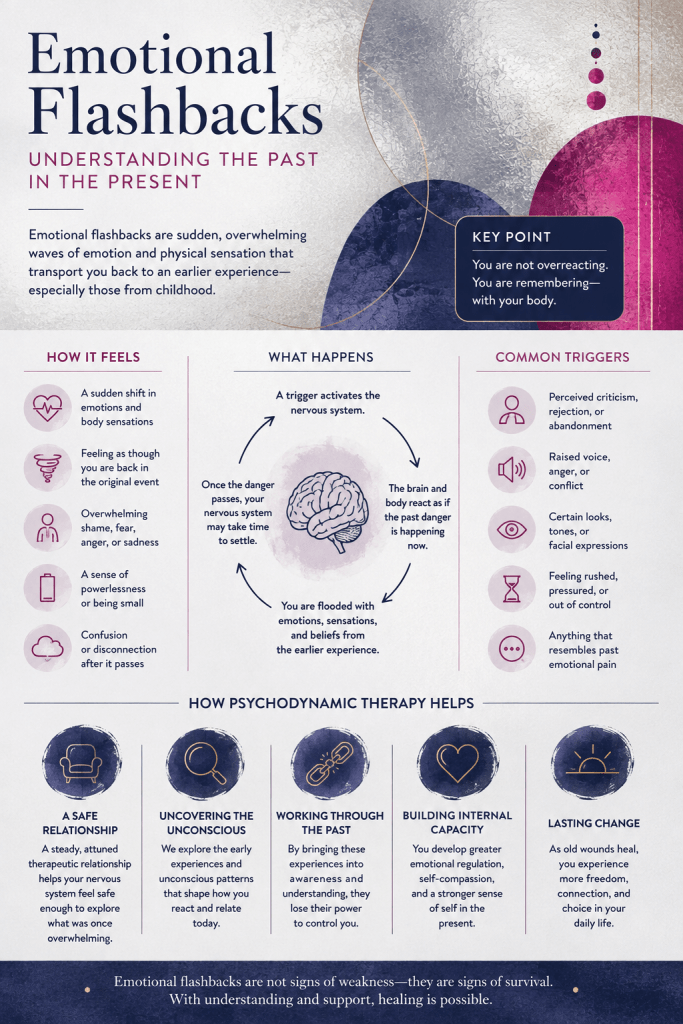
An emotional flashback is the sudden reactivation of emotional states associated with earlier experiences, particularly experiences involving fear, shame, helplessness, rejection, or abandonment.
Rather than vividly remembering a past event, a person may unexpectedly experience emotions that seem far more intense than the current situation would ordinarily explain.
Common emotional experiences include:
- Intense shame.
- Panic.
- Fear of abandonment.
- Helplessness.
- Worthlessness.
- Emotional numbness.
- Feeling small, powerless, or overwhelmed.
The present situation often serves as a trigger, while the emotional intensity reflects earlier experiences that have not been fully integrated.
Emotional Flashbacks Are Different From Memory Flashbacks
When people hear the word flashback, they often imagine vividly reliving traumatic events with detailed visual or sensory memories.
Emotional flashbacks are different.
A person may have little or no conscious recollection of the original event.
Instead, what returns is the emotional experience itself.
For example, someone whose emotional needs were repeatedly dismissed during childhood may experience overwhelming shame after receiving mild constructive criticism as an adult, even when they intellectually recognize that the criticism is respectful and well intentioned.
The emotional response belongs both to the present moment and to earlier experiences that continue to shape expectations.
Why Do Emotional Flashbacks Happen?
The human mind continually compares present experiences with earlier ones.
When a current situation resembles an emotionally significant experience from the past, longstanding emotional responses may become activated automatically.
Common triggers include:
- Feeling criticized.
- Conflict in close relationships.
- Emotional distance from someone important.
- Perceived rejection.
- Feeling ignored or misunderstood.
- Loss of control.
- Situations involving authority figures.
The trigger itself is often less important than the emotional meaning it carries.
Childhood Trauma and Emotional Memory
Many emotional flashbacks have roots in childhood experiences.
Children depend on relationships for both physical and emotional safety.
When those relationships involve chronic fear, unpredictability, neglect, or emotional inconsistency, the nervous system may become especially sensitive to situations that resemble those earlier experiences.
Even years later, similar emotional themes can activate powerful reactions before conscious reflection has time to occur.
Psychodynamic psychotherapy explores these patterns by asking not only what happened, but also what emotional meanings developed in response to those experiences.
Emotional Flashbacks in Everyday Life
Emotional flashbacks do not occur only during major crises.
They often appear in ordinary situations such as:
- Receiving constructive feedback.
- Feeling excluded from a conversation.
- A partner needing time alone.
- A disagreement with a friend.
- Making a mistake at work.
- Feeling uncertain about someone’s feelings.
To another person, these situations may seem relatively minor.
To someone experiencing an emotional flashback, they may evoke feelings of intense danger, shame, or abandonment.
Common Responses to Emotional Flashbacks
People respond to emotional flashbacks in many different ways.
Some become highly anxious or seek reassurance.
Others withdraw emotionally.
Some become intensely self-critical.
Others become angry or defensive without fully understanding why.
These responses often developed as ways of managing overwhelming emotional experiences earlier in life.
Although they may no longer be necessary, they can continue operating automatically.
The Role of the Therapeutic Relationship
Psychodynamic psychotherapy recognizes that emotional flashbacks may also emerge within therapy itself.
Clients may unexpectedly fear disappointing the therapist, anticipate criticism, or worry about being misunderstood.
Rather than viewing these reactions as setbacks, therapy understands them as valuable opportunities to explore longstanding emotional expectations in a safe and reflective environment.
Through this process, people gradually learn to distinguish between past emotional experiences and present relationships.
How Psychodynamic Psychotherapy Helps
Psychodynamic psychotherapy does not aim simply to eliminate emotional reactions.
Instead, it helps people understand where those reactions come from and how they developed.
Treatment often includes:
- Identifying recurring emotional triggers.
- Exploring attachment experiences.
- Understanding unconscious expectations.
- Recognizing patterns of shame and self-criticism.
- Strengthening emotional awareness.
- Developing greater capacity to reflect before reacting.
Over time, emotional experiences that once felt confusing often become more understandable and manageable.
Recovery Is Not About Never Being Triggered
Healing does not mean that emotional flashbacks disappear completely.
Rather, people gradually become better able to recognize when old emotional experiences have been activated.
Instead of automatically reacting as though the past is happening again, they develop greater capacity to pause, reflect, and respond to the present situation.
This process often creates greater emotional flexibility and more satisfying relationships.
Moving Toward Emotional Freedom
Emotional flashbacks can make ordinary situations feel unexpectedly overwhelming.
Without understanding what is happening, people often blame themselves for being “too sensitive” or “overreacting.”
Psychodynamic psychotherapy offers a different perspective.
These intense emotional reactions often reflect earlier experiences that continue to shape present expectations about safety, closeness, criticism, and rejection.
As people better understand these emotional patterns, they often discover that the past gradually loses its power to dictate present relationships.
Healing is not about forgetting earlier experiences.
It is about developing the freedom to respond to today’s relationships as they are, rather than through the emotional expectations formed long ago.
References
- Courtois, C. A., & Ford, J. D. (Eds.). (2016). Treatment of complex trauma: A sequenced, relationship-based approach. Guilford Press.
- Fonagy, P., Gergely, G., Jurist, E. L., & Target, M. (2002). Affect regulation, mentalization, and the development of the self. Other Press.
- Herman, J. L. (2022). Trauma and recovery (Rev. ed.). Basic Books.
- McWilliams, N. (2011). Psychoanalytic diagnosis (2nd ed.). Guilford Press.
- van der Kolk, B. A. (2015). The body keeps the score: Brain, mind, and body. Penguin Books.
Related topics:
- Complex PTSD
- Childhood trauma
- Fear of intimacy
- Emotionally unavailable partners
- Attachment trauma
- Psychodynamic psychotherapy
Thomas Day is a Clinical Professional Counselor providing effective therapy in Nevada. His work integrates psychodynamic theory, object relations theory, attachment theory, and trauma-informed approaches to help clients understand emotional patterns, relationships, and create lasting psychological change.