

Understanding Attachment Theory in Adult Relationships
Written by Thomas Day, Clinical Professional Counselor in Nevada
Many people notice that the same relationship difficulties seem to repeat over time. They may find themselves pursuing emotionally unavailable partners, fearing abandoned despite reassurance, withdrawing when relationships become close, or struggling to trust even those who have proven themselves reliable.
These experiences often feel confusing. People frequently ask themselves, “Why do I keep ending up here?” or “Why do I react this way when I know better?”
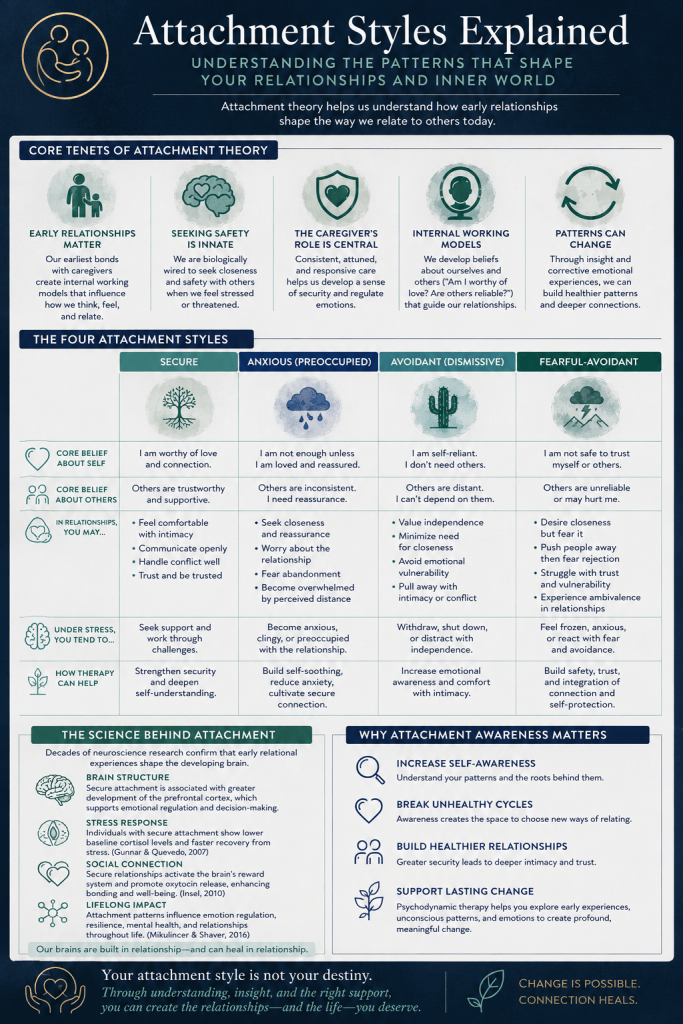
Attachment theory offers a framework for understanding these recurring patterns. Rather than viewing them as personal flaws or fixed personality traits, attachment theory suggests that our earliest relationships help shape expectations about ourselves, others, and the emotional world. These expectations often continue into adulthood, influencing how we experience closeness, conflict, trust, and vulnerability.
Psychodynamic psychotherapy integrates attachment theory into a broader understanding of emotional development, helping individuals recognize longstanding relational patterns while developing greater flexibility in how they relate to themselves and others.
What Is Attachment Theory?
The central idea is straightforward: human beings are biologically prepared to seek safety, comfort, and emotional connection with important caregivers. Through thousands of everyday interactions, children gradually develop expectations about whether others are available, responsive, and emotionally reliable.
These early experiences contribute to what psychologists sometimes call internal working models—implicit expectations about relationships that continue to influence adult life.
Importantly, attachment is not simply about childhood. It continues to shape friendships, romantic relationships, parenting, and even professional relationships throughout adulthood.
Attachment Is a Spectrum, Not a Label
Popular discussions often divide attachment into four fixed categories: secure, anxious, avoidant, and fearful or disorganized.
While these categories are clinically defined and empirically validated, surface-level understanding has oversimplified decades of research into discrete “labels.”. Human relationships are considerably more complex than any single label can capture.
Attachment patterns may vary across different relationships, evolve over time, and change through corrective emotional experiences, including therapy. Rather than asking, “What attachment style am I?” it is often more helpful to ask, “How have my past relationships shaped the expectations I bring into relationships today?”
How Early Relationships Shape Adult Expectations
When caregivers are generally responsive and emotionally available, children often develop confidence that others can be relied upon during times of distress. This foundation supports emotional regulation, resilience, and capacities for intimacy.
When caregiving is inconsistent, rejecting, frightening, or emotionally unavailable, children adapt as best they can. These adaptations are often intelligent responses to the environment they are living in. Over time, however, strategies that once promoted survival may become less helpful in adult relationships.
For example, someone who learned that expressing vulnerability was met with criticism may become highly self-reliant and uncomfortable depending on others. Another person who experienced unpredictable caregiving may become especially sensitive to signs of rejection, even when relationships are generally stable.
Why Relationship Patterns Repeat
Many people notice that they repeatedly find themselves in similar relational situations.
Examples include:
- Feeling drawn to emotionally unavailable partners.
- Becoming overwhelmed by fears of abandonment.
- Pulling away when intimacy increases.
- Feeling responsible for managing other people’s emotions.
- Expecting rejection even in supportive relationships.
These patterns are rarely deliberate choices. Instead, they often reflect deeply learned expectations about how relationships work.
Attachment and Emotional Regulation
Attachment influences not only relationships but also the way people experience and regulate emotions.
When early caregivers consistently helped a child manage distress, the child gradually internalized those capacities. When caregiving was inconsistent or overwhelming, emotional regulation may become more difficult later in life.
Adults may experience emotions as overwhelming, unpredictable, or difficult to identify. Others may distance themselves from emotional experience altogether.
Developing greater emotional awareness and regulation is often an important part of effective therapy.
Attachment Trauma
Not all attachment difficulties result from obvious traumatic events.
Sometimes the most significant experiences involve chronic emotional neglect, inconsistent responsiveness, or the absence of reliable emotional attunement. Although these experiences may not always be recognized as trauma, they can profoundly shape expectations about closeness, safety, and self-worth.
Attachment trauma often influences:
- Trust
- Self-esteem
- Emotional intimacy
- Conflict resolution
- Boundaries
- Sense of belonging
Understanding these experiences can provide a more compassionate perspective on longstanding relationship difficulties.
The Role of Psychodynamic Psychotherapy
Through careful exploration of recurring patterns, thoughts, feelings, and the therapeutic relationship itself, clients often develop greater awareness of how these expectations operate outside conscious awareness.
As therapy progresses, individuals frequently become more able to tolerate vulnerability, communicate emotional needs, establish healthier boundaries, and engage in relationships with greater flexibility.
Can Attachment Patterns Change?
One of the most hopeful findings in attachment research is that attachment is not fixed.
Life experiences, supportive relationships, and psychotherapy can all contribute to meaningful changes in how individuals experience themselves and others.
Change does not usually occur overnight. It develops gradually as new relational experiences begin to challenge longstanding assumptions about safety, trust, and intimacy.
Rather than erasing the past, therapy helps expand the range of possible ways of relating.
Common Misconceptions
“I’m just an anxious attachment person.”
Attachment patterns are not permanent identities. They describe adaptive behaviors rather than fixed personality traits.
“Everything comes from childhood.”
Early experiences matter, but adult relationships, significant life events, and later experiences also influence attachment over time.
“If I understand my attachment style, I’ll automatically change.”
Insight is valuable, but lasting change generally requires new emotional experiences and repeated opportunities to respond differently in relationships.
A More Flexible Way of Relating
Healthy relationships are not defined by the absence of conflict or emotional vulnerability. Rather, they involve the capacity to navigate closeness, disagreement, dependence, autonomy, and repair with increasing flexibility.
Attachment theory provides a framework for understanding why certain relational patterns feel so familiar. Psychodynamic psychotherapy builds upon that understanding by helping individuals explore how those patterns developed, how they continue to operate, and how new ways of relating can gradually emerge.
For many people, this process leads not only to healthier relationships but also to a greater sense of emotional security, self-understanding, and freedom in their daily lives.
References
- Bowlby, J. (1988). A secure base: Parent-child attachment and healthy human development. Basic Books.
- Cassidy, J., & Shaver, P. R. (Eds.). (2016). Handbook of attachment: Theory, research, and clinical applications (3rd ed.). Guilford Press.
- Fonagy, P., Gergely, G., Jurist, E. L., & Target, M. (2002). Affect regulation, mentalization, and the development of the self. Other Press.
- Mikulincer, M., & Shaver, P. R. (2016). Attachment in adulthood: Structure, dynamics, and change (2nd ed.). Guilford Press.
Related topics:
Thomas Day is a Clinical Professional Counselor providing effective therapy in Nevada. His work integrates psychodynamic theory, object relations theory, attachment theory, and trauma-informed approaches to help clients understand emotional patterns, relationships, and create lasting psychological change.