

Why Am I So Hard on Myself? Understanding Self-Criticism
Written by Thomas Day, Clinical Processional Counselor in Nevada
Many people speak to themselves in ways they would never speak to someone they love.
A small mistake becomes proof of failure. An imperfect performance feels unacceptable. Even genuine accomplishments are dismissed as luck or “not good enough.” Instead of offering themselves understanding during difficult moments, they respond with criticism, disappointment, or shame.
Over time, this way of relating to oneself can become so familiar that it feels like part of one’s personality.
People often assume that being self-critical keeps them motivated or prevents failure. While self-criticism may sometimes encourage achievement in the short term, chronic self-criticism usually comes at a significant emotional cost. It is associated with anxiety, depression, perfectionism, low self-esteem, burnout, and difficulties experiencing satisfaction or self-compassion.
Psychodynamic psychotherapy approaches self-criticism differently. Rather than asking people to simply “think positively,” it explores how the inner critical voice developed and what emotional purpose it has come to serve.
What Is Self-Criticism?
Self-criticism is more than recognizing mistakes or taking responsibility for one’s actions.
Healthy self-reflection allows us to learn from experience while maintaining a realistic and compassionate view of ourselves.
Chronic self-criticism is different.
It often involves:
- Feeling that nothing you do is ever good enough.
- Focusing more on mistakes than accomplishments.
- Assuming others are judging you harshly.
- Feeling guilty for having emotional needs.
- Believing you must earn acceptance through achievement.
- Dismissing compliments or success.
- Holding yourself to standards you would never expect of others.
Instead of encouraging growth, chronic self-criticism often creates fear, shame, and emotional exhaustion.
Where Does the Inner Critic Come From?
The critical voice that many people experience did not simply appear overnight.
Throughout childhood, people gradually develop ways of understanding themselves through relationships with important caregivers and other significant figures.
When caregivers respond with warmth, encouragement, and realistic expectations, children often develop an internal voice that is supportive while still capable of acknowledging mistakes.
When relationships are consistently critical, emotionally demanding, unpredictable, or conditional, children may gradually internalize those experiences.
Over time, external criticism can become an internal dialogue.
Even after the original relationships have changed, the inner critic may continue speaking with remarkable consistency.
Self-Criticism as Protection
One of the paradoxes of self-criticism is that it often develops as an attempt to protect us.
For example:
A child who learns that mistakes are met with criticism may begin criticizing themselves first, hoping to avoid future disappointment.
Someone who grows up believing they must perform perfectly to receive approval may become relentless in their pursuit of achievement.
Another person may believe that constant self-monitoring will prevent rejection or failure.
These strategies often make sense in the environments where they developed.
The difficulty is that they frequently continue long after they are needed.
The Difference Between Responsibility and Shame
People sometimes worry that becoming less self-critical means becoming less responsible.
In reality, responsibility and shame are not the same.
Responsibility says:
“I made a mistake, and I can learn from it.”
Shame says:
“I made a mistake because there is something fundamentally wrong with me.”
Psychodynamic psychotherapy helps people recognize this distinction.
Many individuals discover that they become more capable of growth—not less—when they respond to themselves with curiosity rather than condemnation.
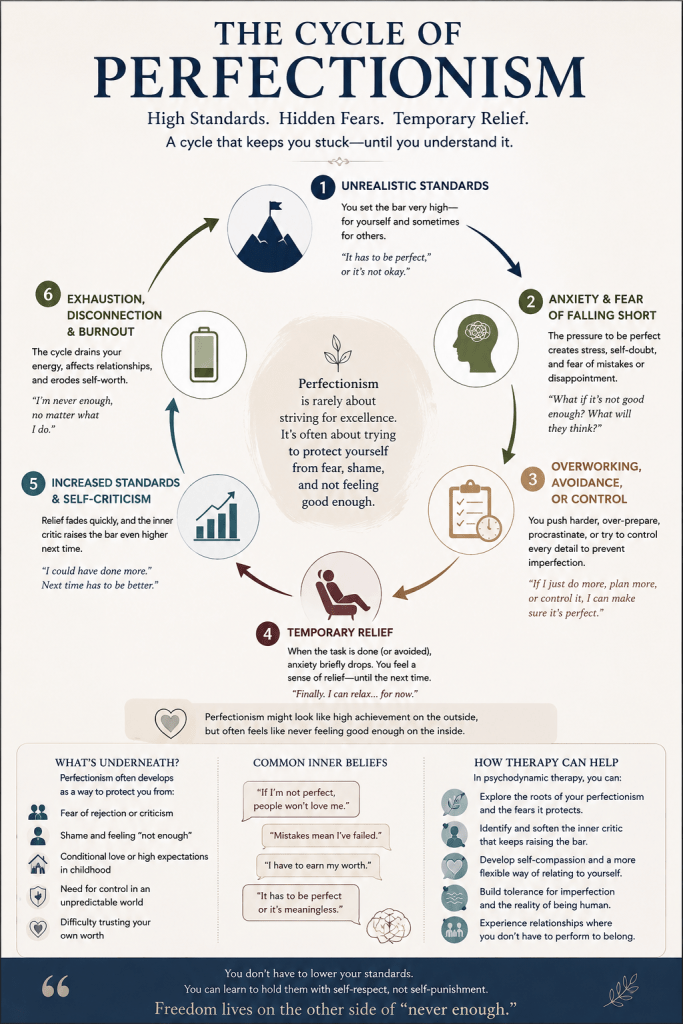
Perfectionism and the Fear of Falling Short
Self-criticism often accompanies perfectionism.
Perfectionism is not always about wanting things to be excellent.
Frequently, it reflects an attempt to prevent feelings of inadequacy, rejection, or humiliation.
If being imperfect once carried emotional consequences, striving for perfection can become a way of maintaining psychological safety.
Unfortunately, perfection is impossible to sustain.
As a result, the inner critic often becomes increasingly demanding while satisfaction remains increasingly difficult to achieve.
How Self-Criticism Affects Relationships
The way people relate to themselves often influences how they relate to others.
Someone who is intensely self-critical may:
- Have difficulty accepting compliments.
- Struggle to believe they are genuinely loved.
- Fear disappointing others.
- Avoid new opportunities because failure feels unbearable.
- Become highly sensitive to criticism.
- Assume others expect perfection.
These patterns can make relationships feel emotionally exhausting, even when others are accepting and supportive.
How Psychodynamic Psychotherapy Helps
Psychodynamic psychotherapy does not seek to silence the inner critic through willpower alone.
Instead, it asks important questions:
- Where did this critical voice originate?
- What relationships shaped it?
- What fears does it attempt to protect against?
- What emotional needs became difficult to acknowledge?
- How has self-criticism influenced relationships, work, and identity?
As therapy progresses, many people begin recognizing that the inner critic is not simply “who they are.”
It is one way they learned to adapt to earlier experiences.
Understanding this often creates space for new ways of relating to oneself.
Developing a Different Relationship With Yourself
The goal of therapy is not to eliminate accountability or ignore mistakes.
Rather, it is to develop an internal relationship that is both honest and compassionate.
People often find they become more resilient when they can acknowledge imperfections without losing their sense of worth.
Instead of responding to setbacks with harsh judgment, they become better able to reflect, learn, and move forward.
This shift supports not only emotional well-being but also healthier relationships, greater creativity, and a stronger sense of identity.
Moving Beyond the Inner Critic
Being hard on yourself is often misunderstood as evidence of high standards or personal discipline.
More often, it reflects longstanding emotional adaptations that once helped navigate important relationships.
Psychodynamic psychotherapy approaches these patterns with curiosity rather than criticism.
As people better understand the origins of their inner critical voice, they often discover that it becomes less dominant. In its place, a more balanced and compassionate relationship with oneself gradually develops.
The goal is not perfection.
It is the freedom to grow, make mistakes, and live with a greater sense of authenticity, resilience, and self-acceptance.
References
- Blatt, S. J. (2004). Experiences of depression: Theoretical, clinical, and research perspectives. American Psychological Association.
- Gilbert, P. (2009). The compassionate mind. New Harbinger Publications.
- McWilliams, N. (2011). Psychoanalytic diagnosis (2nd ed.). Guilford Press.
- Winnicott, D. W. (1965). The maturational processes and the facilitating environment. Hogarth Press.
- Fonagy, P., Gergely, G., Jurist, E. L., & Target, M. (2002). Affect regulation, mentalization, and the development of the self. Other Press.
Related Topics:
- Self-criticism
- Negative self-talk
- Inner critic
- Shame
- Perfectionism
- Psychodynamic psychotherapy
- Self-esteem