

Psychological Defense Mechanisms: Understanding How We Protect Ourselves
Written by Thomas Day, Clinical Professional Counselor in Nevada
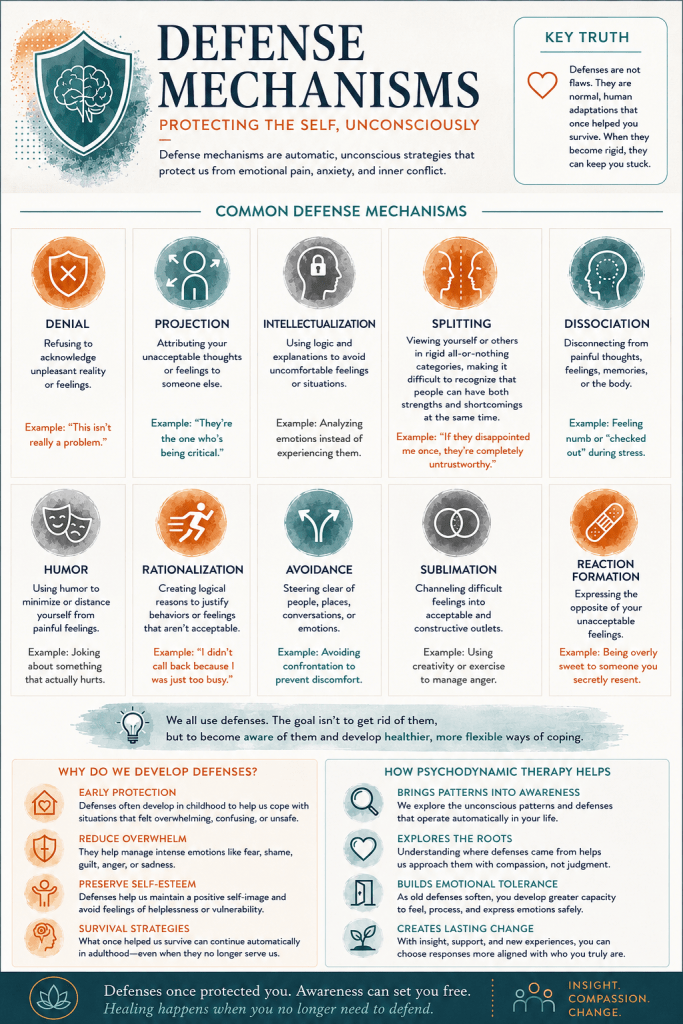
Psychological defense mechanisms are unconscious ways of managing emotions, conflicts, and experiences that feel difficult to tolerate.
Everyone uses defenses. They are not inherently signs of pathology, weakness, or immaturity. In many circumstances, defenses help us function when an experience is overwhelming, threatening, or emotionally complicated.
The difficulty arises when a defense that once protected us becomes rigid or automatic. What helped someone cope in one period of life can eventually interfere with relationships, emotional awareness, or the ability to respond flexibly to present circumstances.
Psychodynamic psychotherapy is particularly interested in this process. Rather than simply asking, “How do I stop doing this?” therapy can explore a deeper question:
“What is this reaction protecting me from having to feel?”
Understanding defenses can therefore be an important part of understanding ourselves.
What Are Defense Mechanisms?
Defense mechanisms are largely unconscious psychological processes that reduce or manage emotional distress.
They can help protect us from feelings such as:
- Anxiety
- Shame
- Guilt
- Grief
- Anger
- Fear
- Vulnerability
- Feelings of helplessness
A defense does not necessarily eliminate the underlying emotion. Instead, it changes how we experience, express, or relate to it.
For example, someone might feel angry but experience themselves primarily as hurt. Someone else might respond to painful circumstances by analyzing them intellectually rather than experiencing the associated emotions.
Neither response is necessarily deliberate.
“I honestly didn’t realize I was doing it. I just thought that’s the way I was.”
That lack of awareness is important. Defenses tend to operate automatically.
Why Do We Develop Defenses?
Defenses often develop because something about an emotional experience feels difficult to manage.
For a child, this can be especially important. Children depend on caregivers for safety and connection, which means that some emotions may feel dangerous when they threaten an important relationship.
A child who learns that anger leads to rejection may learn to suppress anger.
A child who experiences overwhelming circumstances may learn to disconnect from painful feelings.
A child who is frequently criticized may become extremely self-critical in an effort to prevent further criticism.
These adaptations can make sense within the environment in which they developed.
The problem is that psychological patterns can persist long after the original circumstances have changed.
“It made sense when I was younger. I had to keep everyone happy. I just didn’t realize I was still doing it.”
Common Psychological Defense Mechanisms
There are many recognized defense mechanisms, and different psychodynamic traditions organize and describe them somewhat differently. The following are among the most commonly discussed.
1. Denial
Denial involves refusing to acknowledge or fully recognize something that is emotionally difficult to accept.
This can involve denying circumstances, feelings, or their significance.
For example:
“Our relationship is fine. We just don’t really talk anymore.”
Denial can provide temporary protection from painful reality. However, when it becomes persistent, it can prevent someone from responding to circumstances that need attention.
2. Projection
Projection occurs when feelings or impulses that are difficult to recognize in oneself are experienced as belonging primarily to someone else.
For example, someone who feels angry may become convinced that everyone around them is hostile.
“I’m not angry with them. They’re obviously angry with me.”
Projection is not simply being wrong about another person’s feelings. It becomes psychologically meaningful when a person’s own unrecognized emotional experience repeatedly appears to be located in other people.
3. Intellectualization
Intellectualization involves relying heavily on logic, analysis, or abstract thinking to create distance from emotionally uncomfortable experiences.
Someone might be able to explain exactly why a breakup occurred while having very little awareness of how deeply hurt they feel.
“I can explain everything that happened. I just don’t know why I don’t actually feel anything.”
Thinking is not itself a defense. Intellectualization becomes relevant when analysis consistently replaces emotional experience.
This can be particularly subtle because intellectual understanding may look like insight while leaving the underlying emotional experience untouched.
4. Splitting
Splitting involves experiencing people, situations, or aspects of oneself in sharply polarized ways, such as entirely good or entirely bad.
Someone might idealize another person when they feel loved and then experience that same person as completely uncaring following disappointment.
“Yesterday I thought they were the only person who really understood me. Now I feel like they never cared about me at all.”
Splitting can reduce the complexity and uncertainty of emotionally difficult relationships. Integrating contradictory feelings—“I love this person, and I’m also angry with them”—requires a greater capacity to tolerate emotional complexity.
Splitting is particularly associated with some forms of personality organization, but milder forms of polarized thinking can occur in many people under significant stress.
5. Dissociation
Dissociation involves a disruption or disconnection in the normal integration of thoughts, feelings, memories, perceptions, identity, or bodily experience.
It can occur in relatively mild forms, such as feeling detached or “checked out,” and can also be much more pronounced.
Someone experiencing emotional overwhelm might describe:
“I was there, but it felt like I wasn’t really there.”
Dissociation can be particularly relevant in the context of trauma, although it is not exclusive to trauma.
6. Rationalization
Rationalization involves creating plausible explanations for thoughts, feelings, or behaviors that may have other emotional motivations.
For example:
“I didn’t call them back because I was too busy.”
Perhaps that is true. But if the person was actually afraid of rejection, rationalizing the situation may provide protection from recognizing that vulnerability.
Rationalization is not the same as lying. The explanation may feel completely genuine to the person because the underlying motivation is outside conscious awareness.
7. Avoidance
Avoidance involves moving away from situations, people, thoughts, feelings, or experiences that evoke emotional discomfort.
It can take many forms:
- Avoiding difficult conversations
- Withdrawing from relationships
- Procrastinating
- Avoiding situations associated with anxiety
- Distracting oneself from painful emotions
- Refusing to think about difficult experiences
Avoidance often works in the short term.
That is precisely why it can become so persistent.
“I feel better when I don’t think about it. But somehow the same problem keeps coming back.”
Temporary relief can reinforce the behavior, making avoidance increasingly automatic.
8. Reaction Formation
Reaction formation involves expressing or behaving in a way that is substantially different from an unacceptable or difficult underlying feeling.
Someone who feels resentment toward another person might become excessively accommodating or affectionate.
Someone who feels vulnerable might present as unusually independent.
The important question is not whether the outward behavior is sincere. A person may genuinely care about someone while also using excessive agreeableness to defend against anger or conflict.
9. Humor
Humor can be a remarkably adaptive way of coping with painful circumstances.
It becomes potentially defensive when humor consistently creates distance from emotions that might otherwise be experienced.
“I joke about everything. It’s easier than actually talking about how much it hurts.”
Humor can therefore function in different ways depending on the circumstances. It can help someone tolerate difficult emotions, or it can prevent those emotions from being recognized.
10. Sublimation
Sublimation involves channeling difficult impulses or emotions into constructive or socially acceptable activities.
Someone experiencing intense anger might channel that energy into exercise, artistic work, advocacy, or another meaningful activity.
Unlike many defenses, sublimation is generally considered a relatively adaptive way of managing difficult internal experiences.
The emotion does not necessarily have to disappear. Instead, its energy is given a constructive direction.
A Defense Is Not the Same as a Character Flaw
One of the most important things to understand about psychological defenses is that they should not be used as labels for judging people.
Calling someone “defensive” can easily become another way of criticizing them.
Psychodynamic therapy approaches defenses with curiosity.
Instead of:
“Why do I keep doing this?”
the therapeutic question may gradually become:
“When did I first learn that I needed to protect myself this way?”
That shift can make an enormous difference.
A defense usually developed for a reason.
When Helpful Defenses Become Limiting
The goal of psychotherapy is not to eliminate all defenses.
That would neither be realistic nor desirable.
We need psychological ways of regulating distress. The more useful question is whether our defenses remain flexible.
Consider avoidance.
Taking a break from an overwhelming situation can be healthy. Avoiding every difficult conversation can gradually damage relationships.
Similarly, intellectualizing can help someone think clearly during a crisis. But if analysis consistently replaces emotional awareness, important feelings may remain inaccessible.
The same defense can therefore be adaptive in one context and limiting in another.
“Maybe the problem isn’t that I protect myself. Maybe I don’t know how to protect myself in any other way.”
How Childhood and Attachment Can Shape Defenses
Our earliest relationships provide some of the first environments in which we learn what happens when we express emotion.
If a child’s anger is consistently met with punishment, the child may learn to suppress it.
If vulnerability is met with ridicule, the child may become highly self-reliant.
If caregivers are unpredictable, the child may become exceptionally attentive to other people’s moods.
These responses can become internalized patterns.
As adults, we may continue using them even when the original threat is no longer present.
This is one reason psychodynamic therapy pays close attention to relationships.
“I always thought I was just independent. I never considered that needing someone might have become something I learned to avoid.”
Defense Mechanisms in Relationships
Defenses often become most visible in close relationships.
Intimacy brings vulnerability, and vulnerability can activate old expectations.
Someone who fears abandonment might withdraw before another person has the opportunity to leave.
Someone who fears rejection might become excessively accommodating.
Someone who has difficulty tolerating anger might avoid conflict until resentment builds.
Someone who fears dependence might distance themselves whenever a relationship becomes emotionally significant.
These patterns can create painful cycles.
The person withdraws to feel safer.
The other person experiences the withdrawal and moves away.
The resulting distance then seems to confirm the original belief that people cannot be trusted.
This is one reason understanding defenses can be so valuable: it can reveal the pattern occurring underneath the behavior.
How Psychodynamic Therapy Works With Defenses
Psychodynamic psychotherapy does not typically attempt to force defenses away.
Instead, therapist and client gradually become curious about when defenses appear, what emotions they protect against, and whether they remain necessary.
A therapist might notice that a client becomes highly intellectual whenever a particular subject arises.
Rather than saying, “You’re intellectualizing,” the therapist might explore:
Therapist: “I notice that when we get close to what happened, we start talking about the facts of the situation. I wonder what it is like to stay with what you feel for a moment.”
The goal is not to expose or dismantle the defense.
It is to make previously automatic processes more conscious.
With greater awareness, a person can begin developing additional ways of responding.
What Change Can Look Like
Psychological growth does not necessarily mean that a person stops using defenses.
Instead, defenses can become more flexible.
Someone who once avoided every difficult conversation may learn to tolerate discomfort long enough to communicate honestly.
Someone who automatically blamed themselves may become able to recognize anger toward another person without collapsing into guilt.
Someone who withdrew whenever they felt vulnerable may gradually learn that closeness does not always result in rejection.
The underlying capacity is not simply “having fewer defenses.”
It is having more choices.
“I still feel the urge to shut down. But now I can recognize what’s happening before I disappear into it.”
That awareness can create a small but important space between feeling and responding.
A Psychodynamic Way of Looking at Your Own Defenses
If you notice one of these patterns in yourself, the most useful question may not be:
“Which defense mechanism do I have?”
Instead, consider:
- What situations tend to activate this response?
- What emotion appears immediately beforehand?
- What happens inside me when I try not to use the defense?
- What does the defense allow me to avoid feeling?
- What might I fear would happen if I did not protect myself this way?
- Does this response still help me in my current life?
- What alternative response might become possible?
These questions are not intended to produce a diagnosis.
They are invitations to become curious about your own emotional patterns.
When to Seek Professional Help
Defense mechanisms are a normal part of psychological functioning. You do not need to eliminate them simply because you recognize one in yourself.
Professional support may be useful when defensive patterns repeatedly interfere with relationships, emotional intimacy, work, or your ability to understand and regulate your emotions.
Psychodynamic psychotherapy can provide a setting in which these patterns can be explored without judgment. Over time, the goal is greater awareness, emotional flexibility, and freedom to respond differently.
You do not have to stop protecting yourself.
The deeper work is understanding why protection became necessary, what it protects you from, and whether you have more options now.
References
American Psychiatric Association. (2022). Diagnostic and statistical manual of mental disorders (5th ed., text rev.). American Psychiatric Association Publishing. https://doi.org/10.1176/appi.books.9780890425787
Cramer, P. (2006). Protecting the self: Defense mechanisms in action. Guilford Press.
Freud, A. (1936). The ego and the mechanisms of defence. Hogarth Press.
McWilliams, N. (2011). Psychoanalytic diagnosis: Understanding personality structure in the clinical process (2nd ed.). Guilford Press.
Perry, J. C., & Bond, M. (2012). Change in defense mechanisms during long-term dynamic psychotherapy and five-year outcome. American Journal of Psychiatry, 169(9), 916–925. https://doi.org/10.1176/appi.ajp.2012.11091403
Perry, J. C., & Henry, M. (2004). Studying defense mechanisms in psychotherapy. In J. C. Perry (Ed.), The Psychotherapy of the Personality Disorders. American Psychiatric Publishing.
Shedler, J. (2010). The efficacy of psychodynamic psychotherapy. American Psychologist, 65(2), 98–109. https://doi.org/10.1037/a0018378
Vaillant, G. E. (1992). Ego mechanisms of defense: A guide for clinicians and researchers. American Psychiatric Press.
Thomas Day is a Clinical Professional Counselor providing effective therapy in Nevada. His work integrates psychodynamic theory, object relations theory, attachment theory, and trauma-informed approaches to help clients understand emotional patterns, relationships, and create lasting psychological change.